

I changed names and personal details in this story to protect my client’s privacy. I share the past life scenes and words from her Subconscious as they came through.
Nora (not her real name) came to me with a question she had carried for years. She kept finding herself close to people who wouldn’t fully open to her, and she noticed a painful pattern in her relationships. She wanted to know where the root cause of that pattern, and how to exit the cycle.
What followed was one of the most tender QHHT past life regression sessions I have facilitated: a father’s story of grief that ended in laughter.
What happens in a QHHT session
If you’re new to this work, Dolores Cannon developed QHHT (Quantum Healing Hypnosis Technique) over decades of practice. In a session, I guide you into a deeply relaxed state. Your Subconscious chooses what to show you, often a past life, and then I speak directly with the Subconscious to ask the questions you brought. You can read more on my What to Expect page.
The past life: a lantern maker outside the village
Crawling out of the dark
Nora first found herself standing barefoot on cool, damp earth in total darkness. Slowly she realized she was a man in his thirties, with dark hair, a beard, a pointed hat, and worn sandals that were nearly falling apart. Big, tarnished rings set with colored stones covered his fingers. “I think he works with his hands,” she said.
He was inside a cave, and he called it a tomb. He squeezed through a narrow crack toward a bright, bluish-white light and stepped out onto a hilltop above a busy stone village. People in red hats moved through the streets below. He didn’t want to go down there. He knew how ragged he looked, and he knew the villagers would judge him in a way that didn’t reflect who he was. “There’s a contentment on the inside,” Nora said.
A cozy home and a little boy
His real home was tucked away in the shade, a small round dwelling with a dirt floor, a fire, colored glass in the window, and a thick door scarred by wild animals that had tried to get in. A lantern hung from the ceiling. He tapped it proudly and told her, “I made this myself.”
He lived there with his son, a sweet dark-haired boy of five or six. Their favorite ritual was flatbread he made by hand, which they ate with a tiny jar of something sweet while they talked and joked. In the village, he sold the lanterns, bowls, and knives he made from metal and mud. People needed what he made, even if they looked down on the man who made it.
The day everything changed
When I moved Nora to another scene in that life, there was hesitation. Someone had attacked and killed the man’s wife while they were walking, in the moment he turned his head to look at the road ahead. He believed it came from the village, from people who saw his family as less than them. “I can do anything with my hands,” he said. “I can create anything from anything.” And yet he couldn’t save her.
He carried her body a long way to the cave, dug into the earth with his bare hands, and laid her to rest with little blue flowers tucked behind her ears. Then he let himself wail, because he knew that once he walked back out, he had to be strong for his son.
Emptying out and filling back up
In the years that followed, he found his own ways to survive the grief. He climbed to the top of a tall stone building and shouted until the pain left his body. Nora shared that up there, he had thought about ending his life. He stayed because of his son. Instead, he let himself feel whatever he needed to feel. I think many people living with survivor’s guilt will recognize him: the belief that he should have been able to save her, and the slow choice to stay alive for the person who still needed him.
Some people called him the crazy man. A few soft hearts understood. Then he would fill himself back up in secret places only he knew: shady groves full of birdsong, and a cool cave with running water where he and his son splashed their feet. “It’s like he empties and then he fills himself up,” Nora said.
If you’re having thoughts of ending your life, you don’t have to carry them alone. In the US, you can call or text 988 to reach the 988 Suicide & Crisis Lifeline at any time.
A good life, and one regret
At the end of his life he was gray-haired, peaceful, and unafraid. His son was beside him. He told Nora he had lived a full life, with one regret: he had stayed angry at those people. He had held onto the anger like a thorn in his side, because it kept him connected and loyal to his wife. His son, who learned the truth as an adult, never became angry at all. “Your soul is so beautiful,” the father told him. “I learned from that.”
Then he saw his wife, and he went to her.
Laughing on the other side
On the other side, his wife was radiant and expansive. She explained that her soul needed to grow more in the afterlife than it could have in that lifetime, where women of her time had so little room. “Ironically, the constrictor set me free,” she said.
The man got the joke, and he started to laugh. The person who took her life meant to extinguish it, and instead it set her free. The thorn he had carried for a lifetime dissolved, and the two of them laughed together until Nora was laughing too. “Oh, my chest feels lighter,” she said.
What Nora’s subconscious revealed
When I asked Nora’s subconscious why it chose to show her this lifetime, the answer came quickly. Very early in her life, there was a small moment when someone offered her affection and she shut the door on it, without understanding why. She had carried quiet shame about that moment for decades. The Subconscious explained that the reflex came from the lantern maker’s sudden loss. Somewhere deep down, an open heart had come to mean “this equals hurt.”
The Subconscious also told her why it had shown her the little boy’s face so clearly. “That son represents the pure love in her heart that never got extinguished,” it said. “Look at that pure love that you carry.” She didn’t need a wall to protect it. She could choose who gets to see it: people who honor it and aren’t scared of it.
Nora felt the old grief releasing from her solar plexus as we spoke. The Subconscious said the laughter on the other side created that shift.
Notes for all of us from the Subconscious
Many of the messages that came through were for Nora alone. These were universal enough that I want to share them with you.
Bad things happen, and it isn’t personal
Looking back on the lantern maker’s life, the Subconscious said the lesson was that bad things happen, and what matters is what we do with them. It added that it isn’t ours to judge those who hurt us. “Easier said than done,” it admitted, but the principle carries forward despite our human feelings.
Resilience doesn’t have to be perfect
The lantern maker incarnated to learn resilience. He held onto his thorn of anger until the very end, and the Subconscious called his life a success anyway. “No one can really learn it perfectly.”
The soul keeps growing after this life
The wife described the afterlife this way: “Earth is hard, has sharp angles and jagged edges. Afterlife is soft and cushiony and buoyant.” She said growth there is gentle and takes time, and that before you know it, the people you love are with you again.
What draws you to light is your own light
The Subconscious said that when someone is strongly drawn to another person’s light, it means that light already exists within them. Many of us look for in others what we haven’t yet seen in ourselves.
Speak your truth for your own sake
The Subconscious encouraged Nora to say what she notices out loud, even when it’s uncomfortable. It doesn’t matter how the other person reacts; what matters is that she speaks. And if someone squirms while you speak your truth, the Subconscious suggested a little inner smile instead of shrinking. “Oh, there goes my power. There it is.”
You can put your light back where it belongs
Nora sometimes felt her creative energy go hollow when she felt threatened. The Subconscious said that energy was never gone, only displaced, and gave her an image: take the glowing white light around the boy’s head and nestle it right back into her body.
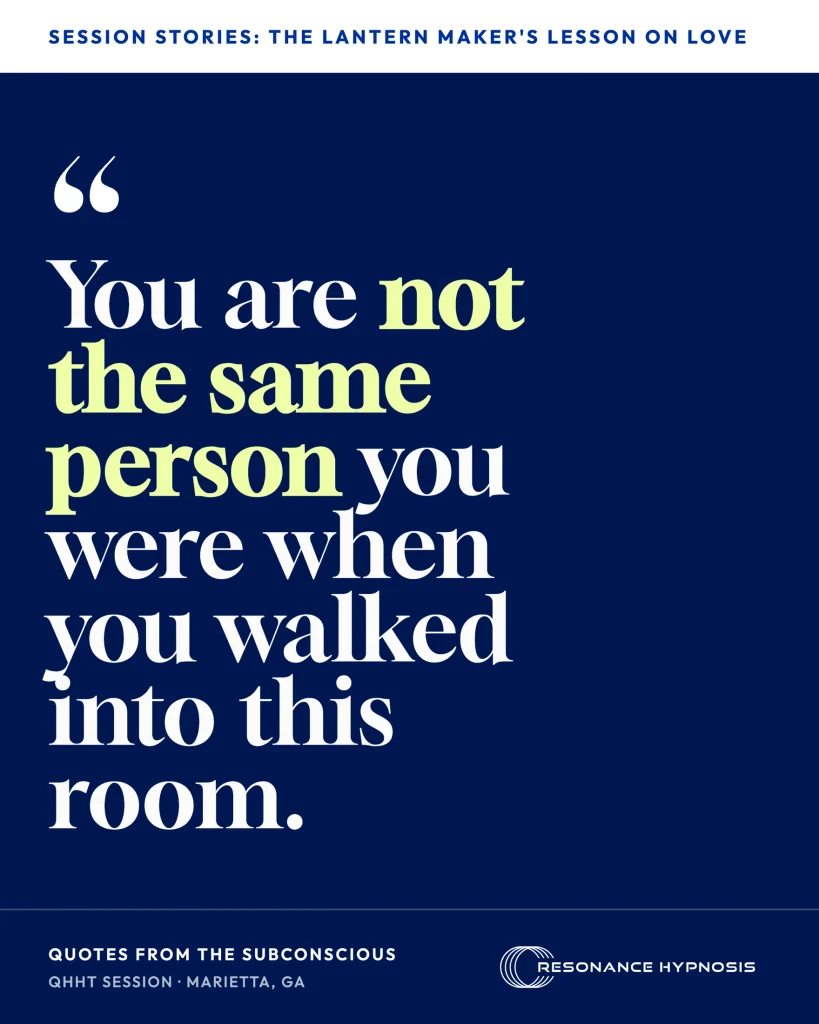
“You are not the same person you were when you walked into this room”
Near the end of our conversation, I asked the Subconscious if there was anything else it wanted Nora to know. It told her: “You are not the same person you were when you walked into this room, and you feel that, and you know that.” It said her body wouldn’t let her go backwards.
Nora said she could see the light inside her, radiating outward. She left lighter than she came in. I felt grateful to have been in the room for it.
Is a QHHT past life regression session right for you?
You don’t need to believe in past lives for a session to help you. (I wrote more about that in Do You Have to Believe in Past Lives for QHHT to Work?) Nora’s story shows how a single session can reach the root of a pattern someone has lived with for decades. That’s one reason I offer QHHT as one long session instead of weekly appointments.
If you have a question you’ve been carrying for years, your Subconscious may already have the answer. I see clients in person in Marietta, GA, and I’d love to hear what you’re curious about.
Schedule your QHHT session with me in Marietta, Georgia or find a practitioner near you. [Never schedule a QHHT session with anyone who is not on the official list of certified practitioners.]